☩
AMDG
AMDG
Confraternity of Christ the King
Consociatio Christi Regis
 CCR RSS Feed
 CCR Atom Feed
 CCR Mastodon Page
 CCR Twitter Page
 CCR: This Day in Christendom Mastodon Feed
 CCR Podcasts
CCR RSS Feed
CCR Atom Feed
CCR Mastodon Page
CCR Twitter Page
CCR: This Day in Christendom Mastodon Feed
CCR Podcasts
CCR Podcasts
CCR RSS Feed
CCR Atom Feed
CCR Mastodon Page
CCR Twitter Page
CCR: This Day in Christendom Mastodon Feed
CCR Podcasts




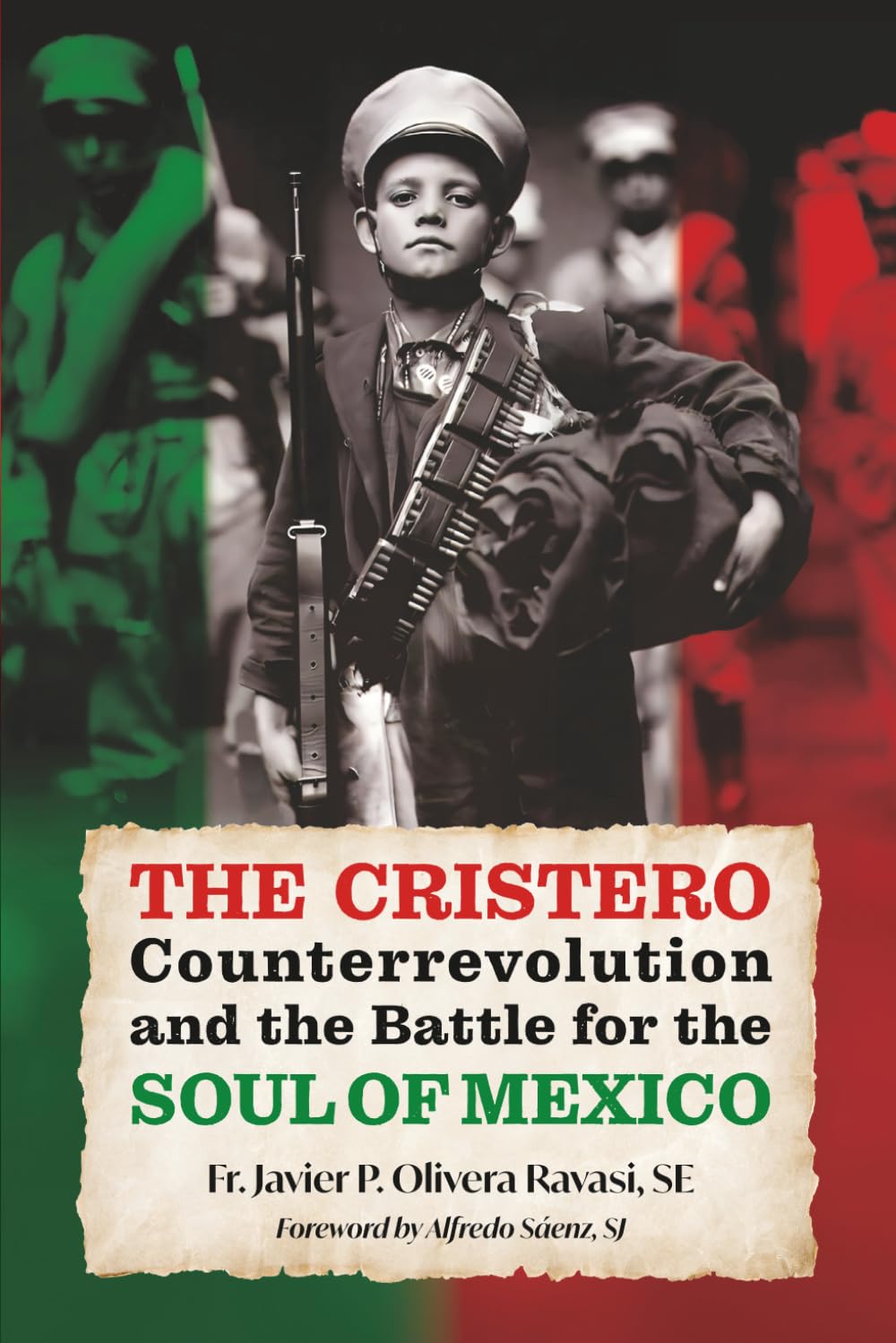
“Poor Mexico! So far from God, and so close to the United States!”
Porfirio Diaz's famous quip, though, is only half true: Mexico has indeed suffered deeply from its proximity to the United States, but it is not, or at least has not been, far from God. Mexico's love for God is written all over its history, and nowhere more clearly and brightly than in the cristiada, more commonly known in English as the Cristero war. Indeed, the very battle cry of the heroes and martyrs of the Cristero wars rings through the mountains, the deserts, and the jungles, from their own day even until our own: ¡Viva Cristo Rey! ¡Viva Nuestra Señora de Guadalupe!
“The ACJM, The League, People's Union, Women's Brigades, etc., were in the trenches safeguarding the unity of the faithful. Everything served to defend their interests: boycotts, petitions through the collection of signatures, demonstrations[,] and, when there was no other way, the bayonet.” p278
Fr. Javier P. Olivera Ravasi's incredibly poignant history begins with a general retelling of the history of Mexico, starting with the history of independence. Mexico's war for independence, oddly enough, was started by two priests, who “opposed the colonial government against King Ferdinand VII”. Independence eventually yielded a Mexican empire, led by an emperor who took the name of Augustín; but it always involved the Catholic religion as an essential, a non-negotiable part of the Mexican identity.
Sadly, though, under the influence of European and American liberals, Mexico was turned onto the path of liberalism and secularism, and eventually the Constitution of 1917 was passed, which essentially placed the Church under the control of the state, and even then only as a necessary evil. Priests had to be registered with the state; the state determined how many priests would be permitted in a given area; all Church property was confiscated; clerics were not permitted to wear distinctive dress in public; and so forth. The Mexican Church could not tolerate such political domination, and rightly resisted it. Eventually, they said, if the law were not changed, they would have to place the whole country under interdict; that is, no sacraments would be available to anyone in the whole country. They believed that this would cause the common people to protest strongly enough to force a change in the law, and they were more than right; but the government still refused. The government did not want to control the Catholic religion; they wanted to eliminate it. Public protest, the devotion of the people to the true faith, was of no moment when compared to this end.
So the people began to organize. Associations of students (the ACJM), of citizens (The League, the People's Union); of women (the Women's Brigades of St. Joan of Arc); all came together to oppose these unjust laws. They even organized an enormous boycott of nearly all commerce in the nation; this boycott was an unprecedented success, with American businessmen seeing a 75% reduction in business. In Guadalajara, out of 25,000 students, 22,000 refused to attend the government schools. One petition to the government for the repeal of the laws had two million signatures, out of a nation of less than thirteen million people. Yet still, the government, let by Plutarco Calles, was unmoved. The Church must be destroyed.
If this book does anything, it impresses on the reader the deeply religious character of the Mexican people. The Mexicans loved Christ the King; they would do anything for Him, including kill or die. Not only did prominent scions of the community rise up to defend the rights of God and His Church—one thinks here of Anacleto González Flores, leader of the acejotaemeros (members of the ACJM, the Catholic Association of Mexican Youth); General Enrique Gorostieta Velarde, uniter of the Cristero armies, long thought to be irreligious but now known to be Catholic; and others—but the common people of Mexico distinguished themselves with their courage and devotion. Hordes of farmers, ranchers, tradesmen, illiterate peasants, educated students, took arms to fight for the reign of Christ the King. These men took the Faith very seriously, and not only believed it, but lived it; indeed, risked everything to defend it.
“However, overwhelmingly their behavior was exemplary—even to their enemies.” p105
These men were deeply moral; indeed, the very casus belli for the war itself was troubling for many of them. Before taking up arms, many organizations—the ACJM, led by González Flores, and the People's Union especially—debated whether doing so could ever be moral. The Mexican hierarchy, and even Rome itself, were unhelpful in the main resolving this moral problem, and when they did speak out, they were against it. Still, eventually the people settled on it being a simple matter of self-defense; if they could fight to defend their mortal lives from unjust aggression, how much more their spiritual lives?
Even so, they were very hesitant to do it; they took arms only when they had exhausted all other options.
An entire chapter, “The Morals of a People at Arms”, is devoted to the Cristero commitment to righteousness. There was, of course, occasional bad behavior among them, as among any group of human beings, and especially when involved in the intensely dangerous activity of waging a war against a much-superior force. “However, overwhelmingly their behavior was exemplary—even to their enemies.” Looting was strictly prohibited; prisoners were to be treated humanely. In one instance, an officer ordered some prisoners shot, and offered the same age-old excuse for this murder as soldiers still offer today:
“The individuals I shot,” replied the officer, “prevented me from marching at every moment, seeking to escape, and I thought it would be better to shoot them. After all, what do you want them for? If you or I fall into their hands, they will not only shoot us but even torture us.”
“All right, but we are not murderers, and if you repeat this, I assure you that you will suffer the same fate,” replied Degollado.
It's important to note that nothing the officer said to justify shooting his prisoners was untrue; they surely were preventing his march, and if he were to fall into Callisto hands, he would certainly be tortured and murdered, as did indeed happen to countless Cristero prisoners. But that doesn't change what is right, and his general assured him that capital punishment awaited him if he refused to treat his prisoners in a moral way.
Fr. Ravasi describes these Cristeros very movingly. These were not modern guerillas; these were modern knights, and their courage, behavior, and treatment of their enemies is more akin to chivalry than to our bloodthirsty modern fighters. What we have here are knights with rifles, and overwhelmingly they conducted themselves as such.
No one could fail to be moved to tears at the love of Christ shown by so many of these Cristeros. They suffered immensely in losing the sacraments, in men being absent from their homes to fight, in the reprisals the federales would from time to time inflict on localities, in the exile or murder of their priests, in the simple knowledge that their own government hated them and all that they most loved. But even so, countless of the people, fighting and not, were willing to make the ultimate sacrifice for Christ the King.
“There is practically no small town that does not have its own martyrs.” p152
The litany of martyrs is as inspiring as it is heartbreaking. The “first martyr” of the Cristero war was José García Farfán, a sixty-six-year-old shopkeeper in Puebla, whose crime was putting up a sign in his shop window: “¡Viva Cristo Rey! ¡Viva la Virgen de Guadalupe!” and “¡Sólo Dios no muere!” This last means simply, “Only God does not die”. Federal troops barged into his shop and demanded that he remove the signs; he refused, and was arrested and taken to prison despite the efforts of locals to rescue him and a local attorney's attempt to use the legal system to spare him. As the firing squad prepared to shoot, the officer said to him, “Let's see now how Catholics die,” and Farfán triumphantly pressed the crucifix on his rosary to his chest. “Like this,” he replied, then shouted, “¡Viva Cristo Rey!”
No one could forget the tale of brave little Joselito, José Sánchez del Río, who gave himself up to capture for the sake of his general (and went down shooting, as well), then was captured, brutally tortured, and executed in front of his parents. When the executioner, finally bored of torturing the boy, asking him what he'd like to tell his parents, José said, “Long live Christ the King, and we'll see each other in heaven!” He was then killed. He had signed his last letter to his mother, knowing that his execution was coming, with joy: “All I regret is that you will grieve. Don't cry, we'll see each other in heaven. José, killed for Christ the King.”
Tomás de la Mora, Zenaida Llerenas, Carmen Robles Ibarra—the list goes on and on.
Perhaps the most inspiring, though, are Anacleto González Flores, the leader of the ACJM, and Father Rodrigo Aguilar Alemán. González Flores was taken prisoner and tortured to reveal the location of Bishop Orozco y Jiménez, one of only two Mexican bishops to remain with their people; though the torture was excruciating, he never betrayed his colleagues. Taken with two friends who would also be executed, he asked that they be shot first, so that he could continue to comfort them until the end. Finally, when asked for any final words, though bleeding profusely and in intense agony, González stated:
General, I forgive you from my heart. Very soon we will see each other before the divine tribunal. The same Judge who is going to judge me will be your Judge, and then you will have in me an intercessor with God… You will kill me, but know that the cause will not die with me. Many are behind me ready to defend it to the point of martyrdom… For the second time let the Americas hear this holy cry: I die, but God does not die!
Fr. Rodrigo Aguilar Alemán was taken by the federales while they desecrated his parish church. He was dragged to the local jail, and on the feast of Christ the King, he was led to a mango tree, still standing in the town, and a rope was thrown over a branch and fastened around his neck. They had been demanding the the priest say, “¡Viva Calles!”, but he had refused. The rope around his neck, the federal asked him, “¿Quién vive?” That is, “Who lives?” The priest responded, “Cristo Rey, y Santa Maria de Guadalupe.” They raised him up by the rope, and after a little while lowered him back down, asking again, “¿Quién vive?” And again, he answered without hesitation, “Cristo Rey, y Santa Maria de Guadalupe.” They repeated this twice more, the first time the priest giving the same answer; on the third time, he gasped out, “¡Viva Cristo Rey y Santa Maria de Guadalupe!” And they finally hanged him until he died.
We all know the tales of Joselito and Fr. Miguel Pro, but there are countless other martyrs of whom most of us know nothing; the whole Mexican people were confessors, and so many were martyred, or were willing to be martyred, that every country should strive for a populace like Mexico's.
This is not really fair; the hierarchy did not sleep the entire war, and did actually do some things to oppose the anti-Catholic Calles laws. But they did not support the Cristeros, almost to a man. Despite a few noble exceptions, this was primarily a layman's war, with priests assisting, while the prelates of Mexico stood aloof, and even Rome, ruled by the great Pius XI, badly mishandled the conflict.
On 1 August 1926, the interdict was laid; this was the hierarchy's role. They threatened the interdict, and they did deliver on it. After that, though, they were essentially absent.
The Cristero war, as a result, was nearly entirely a lay movement. All the great organizations that organized the boycotts and petition—we have mentioned the ACJM, the League, and the People's Union—were lay organizations, which acknowledged the Church but were not dependent on the hierarchy. Some priests remained with their people; some even accompanied the army; a few took up arms themselves. But only two Mexican bishops, Francisco Orozco y Jiménez of Guadalajara and Velasco of Colima, remained with the Cristeros to support them.
In November of 1926, as the uprising continued to increase, with new Cristero forces appearing seemingly every day, the National League for Defense of Religious Liberty (“the League”) wrote to the Mexican bishops, noting that “[n]ever in the history of our country has the collective conscience been formed in the direction of armed resistance. This movement cannot and must not be ignored by the episcopate.” The League therefore asked the Mexican bishops for the following:
1) A negative action, consisting in not condemning the movement. 2) A positive action, consisting of a) sustaining unity of action, by means of agreement on one plan and one leader, b) Forming the collective conscience, by the means within the reach of the Episcopate, in the idea that this is a laudable, meritorious action of legitimate armed defense, c) Canonically enabling military vicars… d) Encouraging and sponsoring a collection vigorously developed with wealthy Catholics, so that they may provide funds that will be designated for the fight, and that, even just once, they may understand their obligation to contribute.
These are comparatively minor asks, to be sure: please don't condemn us; and in addition, maybe help guide us in choosing a single leader, guide us in the moral justification of our cause and how we conduct it, help us receive the sacraments (surely the central responsibility of a bishop), and encourage your people to assist us.
The bishops granted only the first request: they did not condemn the movement. This is better than it might have been, but it surely must be viewed as a tremendous failure of episcopal duties.
The Cristeros fought for three years, one full year without a single leader over all of them; at their peak they had fifty thousand men at arms, and untold thousands of civilians who supported, supplied, spied, and smuggled on their behalf. They ran the governments of multiple states, successfully collected taxes and ran the justice system, and were holding off an enormously superior army that was being equipped and supplied by the much-more advanced United States.
And all this without any meaningful support from their bishops. Only God can say how that support would have bolstered their cause; but surely the Mexican episcopate must be held at least partly responsible for how the uprising would eventually end.
Even Pope Pius XI must be judged rather harshly here. The great founder of the feast of Christ the King extended precious little support to the soldiers of Christ the King fighting in Mexico. He lamented, of course, in multiple documents (Iniquis afflictisque in 1926; Acerba animi in 1932; Firmissimam constantiam in 1937) the persecution of the Church in Mexico, and by his silence at least heavily implied that armed resistance was justified; however, history must judge this support to be woefully inadequate.
“The settlement” that ended the war must be regarded as a colossal failure. As anyone could have predicted, the government did not honor its commitments in the settlement, and the Cristeros were all too often hunted down and killed like dogs once they had laid down their arms. “All the old Cristeros say: More have died after the ‘settlements’ than during the war.” This assertion from the old Cristeros “is widely held to be true” as regards the leaders of the uprising, though of course many more simple soldiers were killed prior to the settlement.
“All the old Cristeros say: More have died after the ‘settlements’ than during the war.”
And the laws were not changed! This must have felt the surest betrayal to these souls who had fought so bravely for Christ the King. The government promised to enforce them more loosely, and the hierarchy promised to reinitiate public worship; that is, lift the interdict. At the request of the hierarchy, in obedience to what the pope and their bishops told them, the vast majority of the Cristeros, despite their deep misgivings, laid down their arms; the government then began a massacre.
In Vera Cruz, Chiapas, and Tabasco, the persecution actually increased after the settlements. In Oaxaca, the government permitted only one priest for every sixty thousand people. And the government was still permitted to make these decisions for the Church! The government still maintained a monopoly on education. Despite the promise of amnesty to all the fighters, many continued to be killed; “[w]hen someone presented the document that he had surendered voluntarily and they gave him guarantees, they put the document on his chest and pierced it with bullets.”
Cristero consciences were sorely abused by the clergy, “[T]hose who had doubts about whether or not they should lay down their arms were subjected to enormous moral pressure from the clergy. There were priests who said ‘that it was a mortal sin to continue feeding the Cristeros’ who remained armed.” And yet history has proven these Cristeros right a thousand times again!
It has been very tempting, in our ultramontanist age, to exculpate Rome, and the great pope Pius XI, for this disaster of a settlement, for this abject surrender disguised as an honorable peace. Perhaps Pius was deceived; perhaps the bishops negotiated the pact without his knowledge. But no; research has established firmly, now that “the Vatican Secret Archives for this period have been opened and classified in an orderly manner, Roman responsibility seems indisputable.” This miserable farce of an agreement must be laid squarely at the feet of Pope Pius XI, and at the feet of all the hierarchy that negotiated it. And Pius himself seems to have realized later that he had erred badly in the settlements; he “himself took responsibility for the decision, which, as Meyer says, ‘quickly forced him to prohibit any talk, writing, or thinking about the settlements.’”
“In short, Calles had won.” The bravery, courage, love, devotion of the Cristeros, maintained for years in the face of overwhelming odds, against a federal government that vastly outnumbered and outgunned them, that was supplied by Mexico's hugely powerful neighbor to the north, and continued in the face of ambivalence or even opposition from the hierarchy of the Church and the God that they loved so much, had been for nothing. Calles had won.
Yet not for nothing; for the Cristeros never surrendered. They laid down their arms, it is true; but they were not defeated on the battlefield, nor did they fear defeat. They were ready to fight and die, to a man, for what was right. They laid down their arms because the Church asked them to; they trusted that the Church would not ask them to do so, were she not right. They were wrong; their trust was misplaced. The Church erred grievously in what she asked, and the Cristeros paid the price for that error. But even their error stemmed from their faith; even their betrayal was their martyrdom and their glory.
The Cristeros never lost; the Cristeros never surrendered. Their legacy can, and must, live on in us, who fight for their goals even today. So even as the hills and valleys of Mexico rang with the cry, the whole world must likewise ring: ¡Viva Cristo Rey! ¡Viva Nuestra Señora de Guadalupe!
Christus vincit! Christus regnat! Christus imperat!